Configuring SRT Input
When you wish to configure SRT for use, you need to select the Input Stream Type item called SRT -> MPEG-TS over SRT, as you can see in Figure 51. Before configuring the IP address and IP port, it is advised to select whether you intend to use Caller/Listener mode. This has a direct impact on what IP you need to provide.
When you select SRT mode:
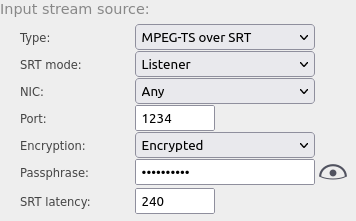
- Listener – Specify the port of the local machine where an external Caller unit will request a connection to start sending data there. If "Any" interface is selected, the SRT connection on the selected port is accepted on all interfaces, thus automatically supporting redundant sources - SRT bonding (for details, see section 4.4). Upon selecting a specific interface, a local IP which is listened on, may be also specified.
- Caller – IP:port of the remote machine from where the data will be sent
It is necessary to define the SRT latency variable in milliseconds (ms). The parameter is the time of intended delay of network packets (a buffer) that is allowed for the connection to slow down the data in transmission in order to provide a time slot to re-send lost UDP packets if they occur. This is what allows the SRT protocol to establish a reliable connection with a focus on removing video disruptions.
Twenty-one encoder also supports the option to enable SRT Encryption. The encryption has to be configured on both ends – caller and listener and uses the same passphrase on both ends (symmetric cryptography). The passphrase needs to have between 10 and 79 characters. Clicking on the icon next to the passphrase you can reveal it.